• Twitter
  • Facebook
  • Pinterest
  • LinkedIn
Call Today: (210) 769-3273 - Se Habla Español    English Español
Law Office of J. Joseph Cohen
  • Home
  • Staff
    • J. Joseph Cohen
    • Carlos Castañeda
    • Randy Vorce
    • Client Reviews
  • Practice Areas
    • Immigration
    • Deportation
    • Employment Visa
    • Family Visa
    • Green Card
    • EB-5 Investor Visa
    • En español
  • Articles
    • Artículos en español
    • Videos
  • Contact
  • Menu Menu
blog

Evidence for Defending Green Card Status in San Antonio

A lawful permanent resident may have a valid Green Card but still face questions about whether the United States remained their permanent home. Extended travel, an overseas job, a foreign residence, inconsistent tax filings, or changing family circumstances can all become part of the government’s review. If you are researching evidence to defend green card status in removal proceedings in San Antonio, TX, the central issue is usually how the documents fit together over time.

The lawful permanent resident status and Green Card matters resource from the Law Office of J. Joseph Cohen provides helpful background on the status at issue. This article focuses on a practical, non-case-specific evidence framework: what records may help show continuing residence, how to address alleged status violations, and why a consistent timeline matters. It is not a substitute for reviewing the allegations and records in an individual case.

What Green Card Evidence Helps Defend Against Removal Based on Abandonment or Status Violations?

A useful evidence collection starts with the concern being raised. Abandonment questions generally focus on whether a permanent resident intended to give up U.S. residence, while other allegations may involve conduct or circumstances that could make a person removable under federal immigration law. A document is most useful when it directly addresses the issue rather than merely showing that the person once lived in the United States.

Evidence of an ongoing U.S. home

Depending on the circumstances, helpful proof of permanent residence may include:

  • Residential leases, mortgage records, utility bills, insurance records, and property-tax documents
  • Bank or credit-card statements showing ordinary U.S. spending and a continuing local address
  • School, childcare, medical, community, or professional records tied to the United States
  • Driver’s license records and consistent address histories
  • Personal statements from family members or others with firsthand knowledge, when appropriate

For a resident in San Antonio, TX, records connected to a home, workplace, school, or family routine in Bexar County may help establish the day-to-day reality of U.S. residence. The value of each item depends on its date, reliability, and relationship to the specific allegation.

Organizing green card abandonment evidence and removal defense documents
A consistent timeline can help put residence, travel, work, and family records into context.

Building a San Antonio Immigration Evidence Checklist

Evidence should be organized as a timeline, not delivered as an unrelated stack of papers. Start with the date the concern allegedly began and work forward. Mark trips outside the United States, changes in employment, moves, tax filings, family events, and communications about where the person intended to live.

Records that may support the timeline

A San Antonio immigration evidence checklist may include the following categories:

  1. Tax records: Federal income-tax returns, filing status, reported address, wage records, and correspondence with tax authorities may provide useful context. Tax treatment can raise questions if it conflicts with claimed permanent residence, but tax documents should be interpreted carefully and not in isolation.
  2. Leases and housing records: Lease agreements, mortgage statements, utility accounts, property insurance, and repair records may show where a person maintained a home and when.
  3. Employment history: Pay statements, employment contracts, employer letters, benefit records, and leave documentation may help explain whether work was based in the United States or abroad. An overseas assignment may have a different significance from an indefinite relocation.
  4. Travel records: Passport pages, boarding passes, airline records, reentry documents, and a personal travel log can help clarify the length and purpose of trips. Dates should be checked against government records whenever possible.
  5. Family and community ties: Records involving a spouse, children, school attendance, caregiving, community participation, or shared household responsibilities may help explain the person’s continuing connection to the United States.
  6. Communications: Emails, messages, calendars, and correspondence may show plans to return, maintain a home, manage U.S. obligations, or complete a temporary assignment. Communications should be preserved in their original context rather than selected only for favorable statements.

In San Antonio, TX, a person may also need to compare local records with federal immigration documents, passport history, and information maintained by agencies such as USCIS, CBP, or ICE. Broader guidance on government and digital records used in immigration enforcement explains why electronic and agency records may matter when constructing a complete timeline.

How Relevance and Consistency Shape LPR Removal Defense Documents

More evidence is not always better. The strongest record is generally one that answers the specific concern, covers the relevant period, and does not conflict with other documents. For example, a lease may support a claimed U.S. residence, but a long-term overseas employment contract, foreign home, or statement describing permanent relocation could require additional explanation.

Before submitting LPR removal defense documents, an attorney may review:

  • Whether dates match across tax returns, travel records, leases, employment files, and immigration forms
  • Whether a document proves residence, explains an absence, or merely shows a brief transaction
  • Whether translations, copies, and source information are adequate for the proceeding
  • Whether a statement is based on firsthand knowledge and remains consistent with other evidence
  • Whether the record addresses an alleged status violation separately from an abandonment allegation

A person should avoid altering, deleting, or selectively presenting records. Preserve potentially relevant material, including records that may require context. Inconsistencies can become important when a Green Card holder later seeks citizenship or makes another immigration filing; how citizenship applications can expose Green Card status concerns offers related background.

Removal proceedings also involve formal allegations and deadlines. The charging document, hearing notices, prior applications, border records, and government evidence should be reviewed together. Readers can explore general information about rights in San Antonio removal proceedings before deciding what questions to raise with counsel. In San Antonio, TX, the applicable process is governed primarily by federal immigration law and immigration-court procedures, not Texas state law.

Frequently Asked Questions

Can tax returns help prove that a Green Card holder maintained U.S. residence?

Tax returns may help show how a person represented their residence and tax status during a particular period. They are not conclusive by themselves. Filing status, reported addresses, foreign income, and statements made to tax authorities may need to be compared with travel, employment, housing, and immigration records. Because tax and immigration rules can differ, a qualified attorney and, when appropriate, a tax professional may help explain how the records fit together.

Do long trips outside the United States automatically mean Green Card abandonment?

No single travel period automatically answers every abandonment question. The length and frequency of trips, the person’s intent, ties to the United States, foreign connections, and conduct before and after travel may all be relevant. Reentry documents do not necessarily resolve every issue. A complete travel history, supported by records and an explanation of the person’s circumstances, may provide more useful context than focusing on one trip alone.

What if my employment required me to work abroad temporarily?

An overseas assignment may be evaluated differently from an indefinite move, but the surrounding evidence matters. Employment contracts, assignment letters, expected return dates, U.S. housing, family arrangements, tax filings, and communications may help explain the purpose and expected duration of the assignment. The effect of the assignment depends on the facts and the allegation. A legal review can help identify gaps or conflicting records without assuming a particular result.

Can family records support a defense to removal based on status concerns?

Family records may help explain residence, caregiving, household responsibilities, and plans to remain connected to the United States. Examples can include school records, shared leases, medical appointment records, or caregiving documentation, provided they are relevant and lawfully obtained. Family ties alone do not resolve an abandonment or status-violation allegation. Their usefulness depends on dates, authenticity, firsthand knowledge, and consistency with the broader evidence.

How Law Office of J. Joseph Cohen Can Help

The Law Office of J. Joseph Cohen is dedicated to helping lawful permanent residents understand the evidence and procedural issues that may arise in removal matters. The firm can evaluate the government’s allegations, organize a chronology, identify potentially relevant records, and discuss how documents may support or complicate the legal analysis. This review may include residence, travel, taxes, employment, family circumstances, communications, and prior immigration filings.

If your Green Card status is being questioned, contact the Law Office of J. Joseph Cohen for a free consultation or case evaluation. The firm is committed to fighting for your rights while helping you explore your legal options.

The information in this article is for educational purposes only and does not constitute legal advice. Contact a qualified attorney licensed in San Antonio, TX for advice specific to your situation.


August 19, 2026
https://jjosephcohen.com/wp-content/uploads/2026/08/evidence-for-defending-green-card-status-san-antonio-620-featured-publisher.webp 1024 1536 Publisher https://jjosephcohen.com/wp-content/uploads/2025/10/logo.webp Publisher2026-08-19 17:02:312026-08-19 17:11:35Evidence for Defending Green Card Status in San Antonio
blog

What Happens at an Immigration Bond Hearing in San Antonio?

If a family member is taken into immigration custody, one of the first questions is often: how can they come home while the deportation case is pending? Understanding how to seek an immigration bond hearing in San Antonio, TX can help families identify the right records, locate the responsible agencies, and prepare for a custody decision. Detention is stressful, but it does not automatically decide the outcome of the underlying removal case.

A bond hearing generally addresses custody and release—not whether a person ultimately has a lawful basis to remain in the United States. Families may need to act quickly because access to documents, communication, and legal assistance can be more difficult after detention. The Law Office of J. Joseph Cohen can help families understand their San Antonio deportation and removal rights while evaluating whether a bond request fits the person’s circumstances.

This guide explains who may be eligible for a bond hearing, what evidence can support a request, how the process may work in the San Antonio area, and why bond preparation should be coordinated with the broader defense strategy.

How to Seek an Immigration Bond Hearing in San Antonio, TX

An immigration bond hearing is a custody proceeding separate from the removal case. In many cases, an immigration judge considers whether the detained person should be released on bond while proceedings continue. The judge may examine whether the person presents a danger to others, is likely to appear for future hearings, or may qualify for release under the applicable immigration rules.

Start by confirming custody and hearing information

Families should generally determine where the person is detained, whether ICE has issued a bond determination, and whether a hearing is already scheduled. The person’s full name, date of birth, country of birth, and immigration identification number can help counsel and family members locate reliable case information. The Executive Office for Immigration Review, commonly called EOIR, provides case-status information, but online or telephone records may not answer every legal question.

Not everyone can request a bond hearing. Certain immigration laws can require detention or limit an immigration judge’s authority to set bond. Prior immigration history, particular criminal allegations or convictions, the manner of entry, and other facts may affect the analysis. A detained immigration attorney in San Antonio can review the record before a family invests time and money in a request that may face jurisdictional barriers.

Evidence and Factors in a San Antonio Immigration Bond Request

When bond authority exists, the person seeking release usually benefits from organized evidence addressing the issues the judge may consider. There is no single document that guarantees release. The value of evidence depends on its reliability, completeness, and connection to the person’s specific circumstances.

Families may begin gathering:

  • A proposed residence and the name of a responsible sponsor
  • Proof of the sponsor’s identity, address, and lawful status when relevant
  • Employment records, school records, or evidence of community ties
  • Letters from family, employers, faith communities, or other people with direct knowledge
  • Proof of family responsibilities, including caregiving arrangements
  • Court dispositions and certified records for prior arrests, charges, or convictions
  • Medical records, prescriptions, treatment plans, or disability-related documentation

Criminal records deserve careful review. An arrest is not the same as a conviction, and the effect of a particular conviction can depend on the exact statute, plea, sentence, and certified disposition. Prior convictions may affect both immigration consequences and the government’s position on custody. Families can review information about criminal convictions that can trigger removal in San Antonio, but a lawyer should evaluate the actual record rather than relying on a description of the offense.

Medical or disability-related evidence may also help explain treatment needs, family dependence, or why a stable release plan is important. Families may find useful context about medical and disability evidence in a detention case. A health condition alone does not guarantee bond, and records should be shared carefully with counsel because privacy and relevance matter.

Family gathering documents for an immigration bond hearing in San Antonio
Families may organize sponsor, residence, employment, and medical evidence for attorney review.

Bond Proceedings, Removal Cases, and Common Mistakes

A bond hearing does not determine whether the person will be deported. It addresses detention and release, while the removal proceeding addresses the government’s allegations and any defenses or forms of relief. A criminal case, if one exists, is a separate matter. Readers can review the difference between criminal prosecution and removal proceedings to understand why one proceeding does not automatically resolve the others.

A thoughtful strategy may include both an immediate custody plan and a longer-term defense review. Depending on the facts, counsel may investigate asylum, cancellation of removal, family-based options, or adjustment of status as a possible defense strategy. The possible relief strategy can affect which records matter and how the family prepares for future hearings, but eligibility must be assessed individually.

Common problems include:

  1. Assuming every detained person automatically has a bond hearing.
  2. Submitting letters without proof of the writer’s identity or relationship to the person.
  3. Omitting prior immigration or criminal history, which can create credibility problems.
  4. Treating release as the end of the removal case.
  5. Missing future court dates, check-ins, or other conditions after release.

In San Antonio, TX, families may need to communicate with ICE Enforcement and Removal Operations, EOIR, detention personnel, and the person’s sponsor. Procedures and available options can vary by location and may change, so current case information and professional review are important.

Frequently Asked Questions

Can a family member request an immigration bond hearing in San Antonio?

A family member may help collect information and documents, but the detained person or legal representative generally must pursue the request through the appropriate immigration process. The first step is often confirming detention location, case information, and whether the person is subject to a custody rule that limits bond authority. An attorney can explain who may file or request a hearing based on the individual record.

Does paying an immigration bond end the deportation case?

No. Payment of bond, if ordered and accepted, generally addresses temporary release from custody. The removal case can continue, and the person may still need to attend immigration court hearings and comply with reporting conditions. Release does not itself provide lawful status or guarantee a defense. Families should treat bond preparation and the underlying case as related but separate legal tasks.

What happens if an immigration judge denies bond?

A denial does not necessarily resolve every possible custody option, but the available next step depends on the reason for denial, the person’s detention category, and the procedural posture of the case. Counsel may review whether additional evidence, a changed circumstance, or another form of review is legally available. Because deadlines and authority can differ, a prompt case-specific assessment is important.

Can immigration bond be reduced after the first hearing?

In some circumstances, a later request may address changed facts or present stronger evidence, but there is no automatic right to a lower amount. The person may need to show why the new information matters, such as a more reliable sponsor or additional documentation. The government may also oppose the request. A lawyer can explain whether seeking another review is permitted and practical.

How Law Office of J. Joseph Cohen Can Help

The Law Office of J. Joseph Cohen is dedicated to helping families understand the custody and removal issues that can arise after detention in the San Antonio area. The firm can evaluate potential bond eligibility, identify gaps in the proposed release plan, organize supporting documentation, and help coordinate the custody request with the broader deportation defense.

The firm is committed to fighting for clients’ rights while providing a clear assessment of available legal options. If a loved one is detained, contact the Law Office of J. Joseph Cohen for a free consultation or case evaluation. A timely conversation may help your family understand what information is needed and how the next steps may be approached.

The information in this article is for educational purposes only and does not constitute legal advice. Contact a qualified attorney licensed in San Antonio, TX for advice specific to your situation.

August 17, 2026
https://jjosephcohen.com/wp-content/uploads/2026/08/what-happens-at-an-immigration-bond-hearing-in-san-antonio-472-featured-publisher.webp 1024 1536 Publisher https://jjosephcohen.com/wp-content/uploads/2025/10/logo.webp Publisher2026-08-17 17:02:322026-08-17 17:10:00What Happens at an Immigration Bond Hearing in San Antonio?
blog, Uncategorized

IMMIGRATION NEWS BITES FROM J. JOSEPH COHEN

June 10, 2021– The Secretary of the Department of Homeland Security, Alejandro N. Mayorkas, provided the Keynote address today at the multi-day Annual Conference of the American Immigration Lawyers Association. He has led a distinguished 30-year career in law enforcement and as an attorney. Secretary Mayorkas is the first Latino and immigrant confirmed to serve as Secretary of Homeland Security and began his career as a federal prosecutor who went on to be appointed the youngest United States Attorney in the nation.  While emphasizing that public safety will continue to be a priority, the Biden administration is committed to making the immigration system more just and fairer than the previous administration. For example, the Department has issued new guidance to its attorneys allowing them to have more discretion in allowing stipulations that are true rather than generally resisting every effort on behalf of a noncitizen in Immigration Court. In addition, while the immigration statutes are phrased in the terms of “illegal aliens”, the common language within the government has now been changed to be more respectful by making reference to “noncitizens.” There will be other changes and he also announced that there will be a new pilot program adding specialty attorneys to resolve appropriate cases faster and perhaps in a more informal manner. Secretary Mayorkas address can be seen here: https://www.youtube.com/watch?v=MZnmqqOVjBU&t=3s


June 16, 2021
https://jjosephcohen.com/wp-content/uploads/2019/06/footer-bg-joseph-cohen-bg-immigration.jpg 729 1600 Attydamg2027 https://jjosephcohen.com/wp-content/uploads/2025/10/logo.webp Attydamg20272021-06-16 20:23:422021-06-16 20:23:42IMMIGRATION NEWS BITES FROM J. JOSEPH COHEN
blog, Successes

Successes

Citizenship– An American grandmother successfully applied in the United States to obtain citizenship for her two Mexican grandchildren after the Department of State denied the application of the mother who is a U.S. citizen at a Mexican consulate.

To view the Certificate o Citizenship, click here.

June 11, 2021
https://jjosephcohen.com/wp-content/uploads/2019/06/eb-5-investor-visa-lawyer-joseph-cohen.jpg 729 1600 Attydamg2027 https://jjosephcohen.com/wp-content/uploads/2025/10/logo.webp Attydamg20272021-06-11 18:21:572022-08-04 18:42:04Successes
blog, Successes

Successes

Removal- The Immigration Court granted withholding of removal after a day long hearing for a mother and son from Honduras that allowed them into the United States with the ability to secure authorization for employment after they were initially returned to Mexico.

To view the written decision and orders of the immigration judge, click here.

June 11, 2021
https://jjosephcohen.com/wp-content/uploads/2019/06/eb-5-investor-visa-lawyer-joseph-cohen.jpg 729 1600 Attydamg2027 https://jjosephcohen.com/wp-content/uploads/2025/10/logo.webp Attydamg20272021-06-11 18:19:492022-08-04 18:42:24Successes
blog, Successes

Successes

Removal– The Immigration Court granted lawful permanent residency to an elderly man who had been in the United States since the 1960s. The initial proceedings had ordered our client removed but the case was appealed and remanded for a new hearing where the Court granted residency.

To view the Order Of The Immigration Judge, click here.

June 11, 2021
https://jjosephcohen.com/wp-content/uploads/2019/06/eb-5-investor-visa-lawyer-joseph-cohen.jpg 729 1600 Attydamg2027 https://jjosephcohen.com/wp-content/uploads/2025/10/logo.webp Attydamg20272021-06-11 18:06:232022-08-04 18:42:44Successes
blog

IMMIGRATION NEWS BITES FROM J. JOSEPH COHEN

June 5, 2021– There continues to be shortages for U.S. workers in a number of industries.  The U.S. Chamber of Commerce is pushing for immigration reform to boost American business with qualified foreign workers.  The Chamber states that “[c]ommonsense immigration reform would boost economic growth, create jobs, and spur innovation and entrepreneurship.” https://www.uschamber.com/immigration  A recent example of the need for workers is demonstrated with  the immediate filling of additional visas for temporary workers who are required to leave the U.S. at the end of their employment.  The H visas are typically used for labor that is needed on a temporary basis often found in agriculture as well as other industries such as landscaping, forestry, and seasonal resort workers. For nonagricultural labor, the cap is set at  33,000 workers for each half of the fiscal year.  The Biden administration recently raised that cap  for an additional 22,000 workers during the current period. Except for 6,000 slots dedicated to certain countries, the other 16,000 slots were filled within days by petitions from around the world. https://www.uscis.gov/working-in-the-united-states/temporary-workers/h-2b-temporary-non-agricultural-workers

June 11, 2021
https://jjosephcohen.com/wp-content/uploads/2021/06/photodune-880690-immigration-xs.jpg 365 548 Attydamg2027 https://jjosephcohen.com/wp-content/uploads/2025/10/logo.webp Attydamg20272021-06-11 14:00:052021-06-11 14:02:36IMMIGRATION NEWS BITES FROM J. JOSEPH COHEN
blog

IMMIGRATION NEWS BITES FROM J. JOSEPH COHEN

April 20, 2021-The drama between border security and those fleeing poverty, crime and corruption in Central and South America continues to play out at our southern border. Immigrants keep making the journey to the border even though the message from the United States government is not to come.  While entry policies have been mixed, many adults are currently being turned away while unaccompanied children are being allowed into United States custody to eventually seek asylum. It has been reported that parents are allowing their children to cross the border while they must remain behind in dangerous and unhealthy conditions. While the administration claims that conditions are getting better for the children, thousands of children who are separated from their families remain in custody in what has been reported as over-crowded holding cells and conditions.  To see a recent statement from the U.S. Department of Homeland Security: https://www.dhs.gov/news/2021/03/16/statement-homeland-security-secretary-alejandro-n-mayorkas-regarding-situation

April 29, 2021
https://jjosephcohen.com/wp-content/uploads/2020/06/Smaller-iStock-498526509.jpg 418 627 Attydamg2027 https://jjosephcohen.com/wp-content/uploads/2025/10/logo.webp Attydamg20272021-04-29 16:25:222021-04-29 16:25:22IMMIGRATION NEWS BITES FROM J. JOSEPH COHEN
blog

IMMIGRATION NEWS BITES FROM J. JOSEPH COHEN

April 13, 2021-United States Immigration and Customs Enforcement (ICE) has been rolling out new guidelines restricting enforcement measures from the previous administration under an Executive Order issued by President Biden.  ICE will more narrowly focus on noncitizens who pose a national security, border security or public safety rather than general non-documented status. As a result, major news outlets are now reporting a significant reduction in arrests by ICE for deportations. For more information from ICE about its program see: https://www.ice.gov/news/releases/ice-announces-temporary-guidelines-its-enforcement-and-removal-operations

April 29, 2021
https://jjosephcohen.com/wp-content/uploads/2019/07/iStock-689373108.jpg 836 1254 Attydamg2027 https://jjosephcohen.com/wp-content/uploads/2025/10/logo.webp Attydamg20272021-04-29 16:24:172021-04-29 16:24:17IMMIGRATION NEWS BITES FROM J. JOSEPH COHEN
blog

Immigration News Bites From J. Joseph Cohen

April 8, 2021-The Department of State has announced that it is working to reduce the backlog of  immigrant and nonimmigrant visas at embassies and consulates that had been blocked by Presidential Proclamations under President Trump.  Priority for immigrant visas include those that had been previously blocked and fiancé visas.  The processing of nonimmigrant visa will be prioritized for travelers with urgent needs, foreign diplomats, mission-critical categories of travelers, followed by some students, exchange visitors, and some temporary employment visas. You may find further information on the Department of State’s website at:

https://travel.state.gov/content/travel/en/News/visas-news/visa-services-operating-status-update.html

April 8, 2021
https://jjosephcohen.com/wp-content/uploads/2019/10/photodune-2257456-us-xs.jpg 365 548 Attydamg2027 https://jjosephcohen.com/wp-content/uploads/2025/10/logo.webp Attydamg20272021-04-08 19:57:152021-04-08 20:01:20Immigration News Bites From J. Joseph Cohen
Page 3 of 512345
  • A couple reviewing blank papers at home, representing marriage adjustment during removal proceedings in San Antonio
    Who May Seek Spousal Adjustment in San Antonio Proceedings?October 28, 2026 - 5:51 pm
  • Blank tax papers at a desk for a San Antonio green card holder nonresident tax return immigration review
    Can Nonresident Tax Filing Affect San Antonio Green Cards?October 26, 2026 - 5:59 pm
  • San Antonio green card holder considering possible N-400 denial and removal concerns
    Could an N-400 Denial Put San Antonio Green Cards at Risk?October 21, 2026 - 6:46 pm
  • Employer closure and employment-based green card concerns in San Antonio
    After Closure, Which Records Matter in Green Card Removal?October 19, 2026 - 5:46 pm
  • Green card rescission proceedings represented by a San Antonio resident reviewing a blank paper notice
    Can Green Card Rescission Skip Court in San Antonio, TX?October 14, 2026 - 5:40 pm

CALL NOW
(210) 769-3273

OR FILL OUT OUR CASE REFERRAL

CASE REFERRAL

Immigration Services

Follow a manual added link

DEPORTATION

Deportation is a legal process that is now also known as removal. Deportation or removal is the process that authorities use to remove a person from the United States. Individuals who commit crimes or overstay a visa are examples of persons who could face deportation.

Follow a manual added link

EMPLOYMENT

If you want to live and work in the U.S., you may be able to do so with an employment visa. In some cases, employment visas can lead to permanent immigration, while in other cases, these visas are only issued on a temporary basis.

Follow a manual added link

FAMILY VISA

U.S. Citizenship and Immigration provides certain provisions for U.S. citizens and lawful permanent residents to petition for their family members to receive visas that lead to lawful permanent residency with a green card. If you are U.S.

Follow a manual added link

GREEN CARD VISA

Having a green card as a lawful permanent resident, grants an immigrant certain important rights and privileges in the U.S. With a green card, a person can work in the U.S. and with a green card, the permanent resident is granted legal protection under U.S. law.

About

I bring a unique perspective to the practice of immigration law with years of legal, government and overseas experience. 

  • Advanced Certificate in Immigration Law Studies
  • Court appointed immigration attorney for criminal cases
  • 2019 immigration speaker for National Business Institute
  • 2019 immigration speaker at the San Antonio Bar Association
  • Treasurer of the Immigration & Nationality Law Section of the San Antonio Bar Association

Quick Links

Home

J.Joseph Cohen

Immigration

Employment Visa

Deportation

Contact

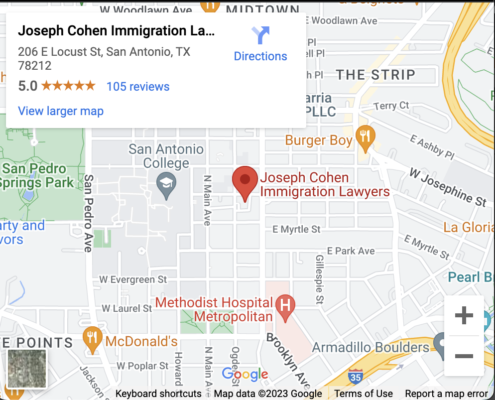
Location

Contact

  • Address

    206 East Locust Street
    San Antonio, Texas 78212

  • Call Today

    (210) 769-3273

Disclaimer: This is an advertisement. This web site is designed for general informational purposes only. This information or contacting me through this website does not create an attorney-client relationship.

Copyright 2023 Law Office of J. Joseph Cohen | All Rights Reserved |
Legal Marketing Solutions by USAttorneys.com

  • Twitter
  • Facebook
  • Pinterest
  • LinkedIn
Scroll to top
  • <
  • <